Completed ATHENA: Bringing Accessibility and Design for All into Higher Education Curricula
ATHENA project aims to bring Accessibility and Design for All into Higher Education Curricula by developing and testing guidelines and recommendations which will stimulate innovative learning and teaching practices to tackle social inclusion of persons with disabilities.
ATHENA project aims to bring Accessibility and Design for All into Higher Education Curricula by developing and testing guidelines and recommendations which will stimulate innovative learning and teaching practices to tackle social inclusion of persons with disabilities.
Sign the Nicosia Declaration
From margins to mainstream: integrating Accessibility and Universal Design across Higher Education curricula
Built on the ATHENA Project and presented at the AAATE Conference in Cyprus on 11th September, the declaration is a call to action for universities, governments, accreditation bodies, associations and individuals. It urges the full integration of accessibility and universal design as core elements of higher education policy, curriculum design, institutional governance, and quality assurance mechanisms.
Objectives
- Increase the quality in the work of involved universities and HE institutions
- Create collaboration among HE institutions and organisations representing persons with disabilities
- Work transnationally and across sectors
- Address a central priority in the field of education and training
- Enable change at organisational and personal level
Funder: Funded by the Education, Audiovisual and Culture Executive Agency (EACEA) as part of the Erasmus+ Cooperation Partnership action.
Timeframe: The total framework of this project is 30 months
Partners
The project is leading by EDF working together with the following partners:
- Johannes Kepler University Linz
- Universitat Autònoma de Barcelona
- European University Cyprus
- Masaryk University
- EURASHE
Associated partners:
- IAAP EU – International Association of Accessibility Professional
- AAATE – Association for the Advancement of Assistive Technology in Europe

Transnational Report – State of the Art: Mainstream Curricula Analysis
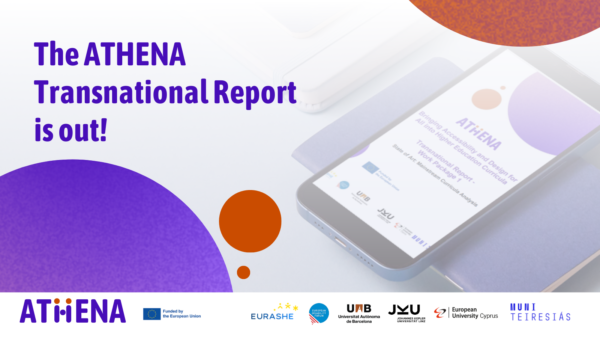
- Read about the project findings in our article
- WP1 Transnational Report – State of the Art: Mainstream Curricula Analysis in PDF
- WP1 Transnational Report – State of the Art: Mainstream Curricula Analysis in Word
Recommendations
Athena partners developed a set of recommendations on how implementing accessibility and universal design in HE curricula. These recommendations are addressed to a wide range of stakeholders including policymakers, quality agencies and accreditation bodies, educational leaders, programme creators, instructors, and user representatives.
The recommendations deal with key aspects such as: legal framework, financial support, curriculum design, staff training, and learning outcomes.
- ATEHNA Work Package 2 – Recommendations in PDF
- ATHENA – Friendly version – Recommendations on the integration of accessibility and universal design in higher education curricula (Word)
- ATHENA – Friendly version – Recommendations on the integration of accessibility and universal design in higher education curricula (PDF)
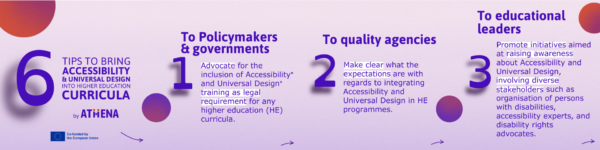
Athena Accessibility tips infographic banner 1/2
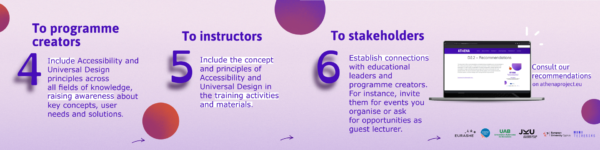
Athena Accessibility tips infographic banner 2/2
Focus groups
Held in various European countries, these discussions informed the set of recommendations that can be found in Deliverable D2.2 “Recommendations on the integration of accessibility and Universal Design in higher education curricula, including sample modules”.
Report on consultations and cooperation
The aim of the consultation was to assess the feasibility of a set of recommendations included in Deliverable 2.2 “Recommendations on the integration of accessibility and Universal Design in higher education curricula, including sample modules”, identify potential challenges and gain insight into practical strategies for implementation.
In total, 17 representatives from macro-level bodies in the five project countries (Austria, Belgium, Cyprus, Czechia and Spain) provided their perspectives through an online survey conducted between November and mid-December 2024.
Policy-Position Paper
This policy position paper discusses the implications of the ATHENA project. The policy implications can provide the impetus to establish the ideological foundations and actionable strategies to develop legal frameworks, financial support systems, curriculum design approaches, staff training programs and learning outcomes conducive to creating inclusive social environments.
Athena WP3 D3.4 Policy Position Paper
Latest
Contact
Roberta Lulli, EDF Project officer: roberta.lulli@edf-feph.com
Project website
Disclaimer
Project funded by the European Union. Views and opinions expressed are however those of the author(s) only and do not necessarily reflect those of the European Union or the Education, Audiovisual and Culture Executive Agency (EACEA) . Neither the European Union nor the granting authority can be held responsible for them.