The United Nations Committee on the Rights of Persons with Disabilities is reviewing the European Union’s compliance with its disability rights treaty on 11 and 12 March.
These two days will feature dialogues between European Union officials and a committee of experts. These Experts will examine what the EU is (and is not) doing to advance the rights inscribed in the Convention.
But this dialogue is part of a larger process. To understand the process and how you can follow it, our Communications team talked with a “pro” in following the UN Committee procedures – Marine Uldry, our Human Rights Policy Coordinator, who supports our members every year on these reviews.
Summary
- It’s important to prepare by reading supporting documents like reports by civil society and the Committee’s list of questions (called “list of issues”).
- The 11 and 12 March are public events that can be followed live – but a lot of the work is done before and after.
- The Concluding Observations, to be published in April, will represent a valuable tool in advocacy.
What is the UN review?
First, we wanted to understand why the UN is reviewing the EU and what that leads to. “This is a normal process for all the State Parties to the Convention (meaning countries and organisations like the EU that adopted the Convention).” Marine tells us, “The United Nations monitor how their treaties are fulfilled, and these periodic reviews are a way to do it.”
It’s not the first time that the European Union gets reviewed. But it’s a unique process. Marine shares that “The European Union ratified the treaty as a ‘regional integration organisation’. This means that the experts are just reviewing its specific legal competencies, not what happens in each EU country.”
Does this mean that specific demands of Danish, Spanish or Luxembourgish citizens with disabilities will be brought up? “They can, if they refer to a wider problem EU Institutions can directly work on, like travelling across borders or problems getting the jobs in the EU institutions.” But she points out that countries also get reviewed. “All European Union countries ratified the treaty, and they also get reviewed regularly. For example, Belgium, the Netherlands and Denmark got reviewed last year. This August, it will be Finland.”
How do the experts know what is happening, though? Marine explains that these two days are “part of a wider process”. “It started years ago, when the Committee issued a list of questions (called “list of issues”) to which the European Commission had to reply to explain the implementation of the Convention. Based on the reply, the experts are preparing a list of topics they want to tackle in these two days.”
Civil society is involved and consulted in the process. “We gave feedback to experts on the issues that the EU needs to tackle. And just this week, we launched our own report, that will help the experts have a full view of the situation”
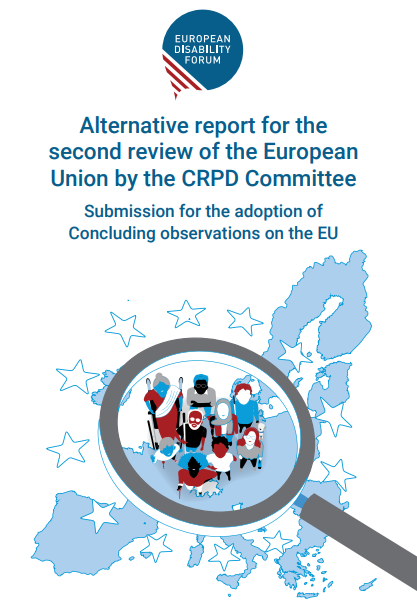
Marine adds that “We will also be in Geneva having (private) meetings with the experts to explain in more details the main problems we identified and give them the most updated information.” Marine explains there is a lot of participation and interest by civil society. “We expect many organisations to be present in Geneva to inform the Committee, and we try to coordinate this process to make it the more useful and efficient. It’s a great sign that so many organisations want to participate.”
The experts come from a wide range of countries. Should we be concerned about conflicts of interest? “No. It’s actually good that, for the first time, the EU has an expert on the Committee.” Marine explains “Inmaculada (Placencia-Porrero, the member of the committee that was elected with the support of the EU) will not be part of the review process of the EU. But her knowledge during national review processes helps other experts understand what national competencies and EU-wide competencies are. And she has a very strong knowledge of the European reality.”
Preparation
After establishing that the process is already in full swing, we asked Marine how organisations and activists can prepare to follow these two days.
“I would start by checking the materials that the United Nations makes available. They gather not only the list of issues the experts identified for discussion, but also the opinions of organisations like the European Disability Forum.” They are published in a centralised database, and often, easier-to-read versions are made available on the organisations’ websites.
Following the discussions
“The discussions between the EU representatives and the Committee will be live-streamed to everyone through the UN webtv.” Marine says. They take place in Geneva, Switzerland and don’t take the entirety of the day. She explains “The public dialogue with the EU will be only the afternoons of the 11 and 12 (March)”. They will take place from 15:00 to 18:00 CET (Geneva time). The mornings will be taken by the review of Canada (11 March) and Palau (12 March).

What if you aren’t available or cannot make it through the whole time? “The European Disability Forum will probably provide a summary of the day in its social media channels”. Here, André, our Communications Manager interjects, “You can follow our Twitter and Linkedin accounts, but also of other European NGOs that are deeply involved in the process, like the European Blind Union.”
She adds that you can also watch it later “And you can always watch the recordings later. As the whole dialogue will be recorded, we can keep EU representatives accountable to their words.”
But, if you can’t follow live it’s not a big deal. Because as Marine told us “This is not the end of the process. The strong advocacy tools will come from the Concluding Observations, in April.”
The rest of the process
Yes, because while the events on 11 and 12 March represent the most visible part of this process, it’s not the end. “The experts will deliberate and release what we call “Concluding Observations”. These are call for specific actions so the EU can course-correct on its implementation of the Convention.”
And when would they be published? “We expect sometime in April, but we don’t know the exact date.”
They will then be another powerful tool for disability advocates to use. So, what does the European disability movement expect from these observations?

“Well, our report shows that a lack of leadership is to blame for the gaps in upholding disability rights. To fix that, we need an updated Disability Rights Strategy with strong actions for the next 5 years.”
In addition, Marine points out the need for other actions: “The EU didn’t ratify the Optional Protocol (to the Convention). They should do that now.” The Optional Protocol essentially allows the Committee to receive and consider individual or group complaints outside this structured review process.
Finally, she adds that the role of civil society needs to be recognised “We have a quite unique practice in which the EU gives structural funding to civil society organisations that complement and often criticise their work without restricting their independence. The Committee can recognise it and ask for it to be strengthened.”