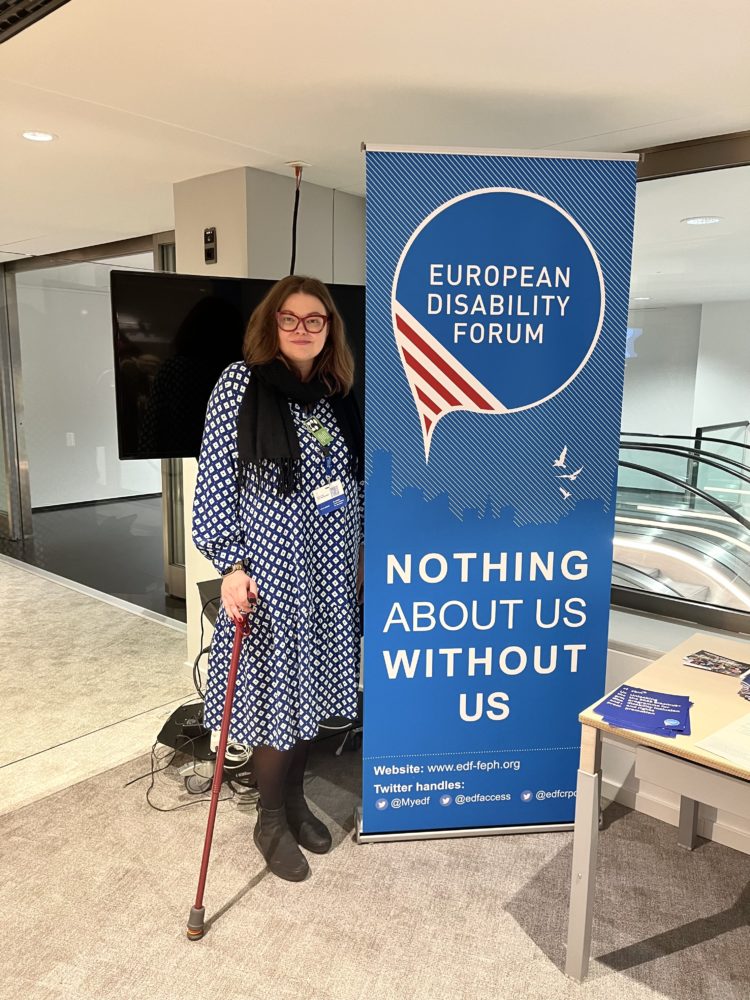
Adéla Odrihocká is a professional interpreter and translator specialising in healthcare and pharmaceuticals. However, her career path has led her to dedicate her work entirely to the field of rare diseases—a journey she deeply values.
She is a board member of Rare Diseases Czech Republic, the national umbrella organisation, and leads a patient organisation for Ehlers-Danlos syndromes in the country. In addition, she volunteers with EURORDIS as part of the Social Policy Action Group (SPAG), consults for the Czech Ministry of Health, and coordinates projects for a European Reference Network at a university hospital in Prague.
Beyond her professional commitments, she enjoys spending time with family and friends, attending cultural events, traveling, learning languages, and meeting new people. She also has a passion for cooking and hosting gatherings at home.
We sit down with Adéla to explore her personal journey as someone living with a rare disease and a disability.
Question: How has your condition shaped your daily life and routines?
Thank you for this question, that’s a good one. It has shaped my life a lot. I think that’s a part we don’t talk about very often, the hidden aspects of life with a chronic condition. It turns your life upside down, and you need to find balance, which is possible. Living with a chronic, rare, and incurable condition is definitely challenging, but I like to say that it doesn’t mean it can’t be beautiful and fulfilling. It can, because, speaking for myself, my life is fulfilling just the way I want it to be. I do what I enjoy, and I’ve always been fortunate to have incredible people around me.
I don’t live despite my disability and incurable condition, as we often hear in the media, I live with it. I adapt, find solutions, 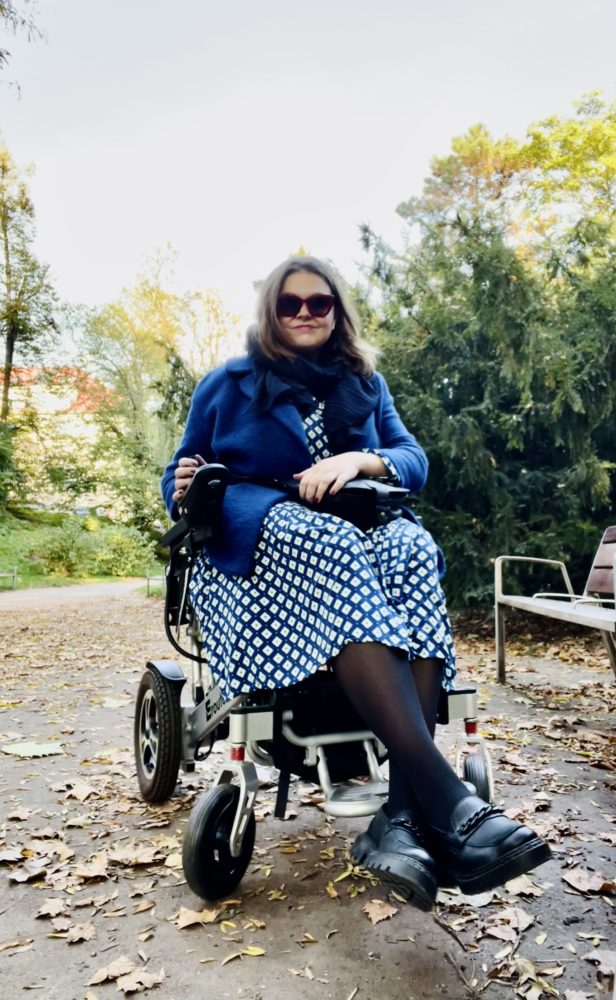 and live within my possibilities. I put my energy only into what fulfills me because I cannot afford to waste my already limited energy on something that doesn’t make sense to me. I appreciate time, enjoy the little things, avoid unnecessary worries, and don’t complicate my life.
But it also takes a lot of daily routine, discipline, and efficient management of my very limited energy and time. Any small change in my schedule can disrupt my functioning, requiring me to reorganize my entire week, I plan everything down to the minute. You learn to be highly adaptable, constantly adjusting to the society, a society that hasn’t been built with us in mind, your ever-changing, dynamic health condition, and new medical issues that arise every few months. You’re always seeking balance.
I believe that the ability to adapt is a crucial skill to have in life, even if you don’t have a condition. When you master it, nothing feels impossible because you know that everything is solvable and manageable.
Question: What do you think are some misconceptions people have about the rare diseases and people with invisible disabilities?
One misconception might be that rare diseases don’t alter your quality of life. But according to the latest results of the Rare Barometer Survey, 8 in 10 people with rare diseases also live with a disability. A common misconception about invisible disabilities is that if you can’t see it, it doesn’t exist, or that it is less severe, or that its impact isn’t significant, which is not true. That’s why people living with invisible conditions are often not believed, misunderstood, and dismissed.
Question: What kind of support or accommodations make the biggest difference for you?
It depends on the field. In the professional field, it’s definitely a flexible working schedule and the option to work from home. Without the possibility of working from home, it would be very difficult, if not impossible, to maintain a professional activity, or not to the extent that I am able to do today. During conferences or events, having a rest room or quiet room where I can rest and calm down my physical symptoms makes a huge difference. It allows me to participate fully or even stay the whole day.
In my personal life, what is very important to me are all the accommodations I’ve made in my house to meet my needs: those little accessibility gadgets and hacks. If we can consider them accommodations, it would also be my mobility aids, which allow me to experience a freedom of movement I would not be able to enjoy otherwise.
Question: As a volunteer at EURORDIS, what inspired you to become an advocate?
My own life experience, the very long and challenging diagnostic odyssey I went through, and later on, the experience of the entire rare disease community: not just the Ehlers-Danlos community, but the whole rare disease community. I saw that even though we might live with different conditions, we really do face the same issues and challenges. My driving force has always been that I don’t want this community to go through what I experienced during my diagnostic odyssey, which was not easy. And I consider that if I have a voice today, it’s my responsibility to use it wisely, on behalf of the entire community.
Question: What challenges have you faced while advocating for awareness and change? And what advice would you give to others who want to raise awareness or advocate for their own communities?
One of the biggest challenges we face is fragmented healthcare, the lack of multidisciplinary care, and poor care coordination in rare diseases. Advocacy efforts often focus on pushing for systemic changes, such as the implementation of care coordinators. Another challenge is that the healthcare and social systems in some countries do not work together; they function separately, and that’s a huge issue.
 Another challenge is the emotional toll, as well as the physical, financial, and systemic barriers, especially the bureaucratic ones. But also, a very basic challenge is that sometimes people believe rare diseases are too rare to require attention. Many people think they’ll never meet anyone with a rare disease. But it’s getting better, thanks to all the awareness efforts.
As for advice for someone who wants to raise awareness: It doesn’t have to be big. You can start small, and each effort counts. You can begin by raising awareness in your city, making flyers, use social media or just talking about it with those around you. That’s how huge changes always begin.
Question: What policies would make the biggest impact for people with rare diseases?
That would be a very long answer from my side, but I would say that any policy that contributes to a better quality of life for people living with rare diseases, ensures a life of dignity, provides access to healthcare and social care, and promotes equal access to opportunities and social participation, would make the biggest impact.
We appreciate Adéla for sharing her time and personal journey with us.
Learn more about Adéla and her work on her LinkedIn.