The European Disability Forum (EDF) took part in the Future of Work in the Age of AI Forum on 16 March 2026 in Riga, Latvia.
The State Employment Agency of Latvia, ERDA, and the Future of Work Institute organised the event, with support from Google.
We were represented by our President, Gunta Anca, and Senior Project Officer Roberta Lulli, who leads the Empowered by AI project.
The event gathered more than 700 participants and over 60 speakers from across Europe. They discussed how artificial intelligence (AI) is reshaping labour markets, public services, and society. Speakers focused on how to strengthen Europe’s competitiveness and resilience while keeping people at the centre of technological change.
For a fair and accessible AI transition
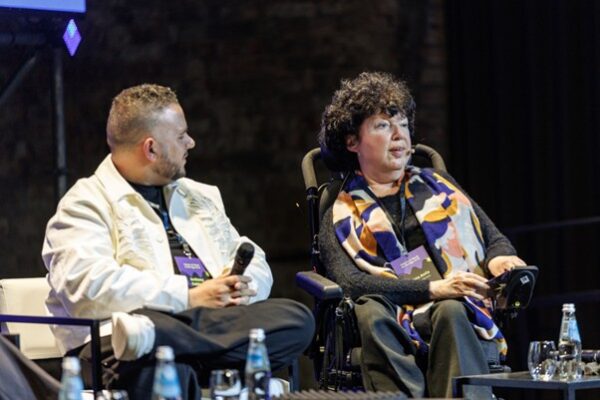
Gunta Anca spoke in the panel ‘Ensuring the AI Transition Is Fair and Accessible’. Rachael Bleakley, Google.org Regional Manager for EMEA, moderated the session. Gunta was joined by Susanna Laurin, Managing Director and Chair of the Funka Foundation; Greta Metka Barbo Škerbinc, President of the World Association of Public Employment Services (WAPES); and Anthony Babkine, Co‑founder and General Delegate at Diversidays.
During the discussion, Gunta highlighted that for the 100 million persons with disabilities living in the European Union (EU), AI can be either a powerful bridge to inclusion or a new barrier. She explained that outcomes depend on:
- how systems are designed
- who takes part in development
- whether accessibility and human rights are included from the start
At EDF, this principle guides our work. As Gunta explained, we have been actively engaged in shaping the EU Artificial Intelligence Act to ensure strong safeguards for persons with disabilities. But legislation is only one part of the solution. Gunta added:
We are also working to make sure that people with disabilities in Europe can develop AI skills and feel empowered to work on and with AI
The role of developers
Artificial Intelligence (AI) has enormous potential to support communication, improve access to services, enhance independent living and transform mobility. However, these benefits are not guaranteed. Without inclusive design, AI can reinforce discrimination, for example:
- interview systems that analyse body language or eye contact
- or digital tools that are inaccessible
AI can also increase exposure to fraud and disinformation. Gunta highlighted the responsibility of developers:
Developers have the potential to change this.
She added:
AI works better and fairer when diversity and inclusion are part of the design, the data and the development team from the start.
What needs to change
For EDF, the message is clear: accessibility and inclusion are not optional. They must be embedded from the start of the AI development process. This means:
- engaging with persons with disabilities and their representative organisations
- considering diverse needs at every stage of development
- continuously monitoring systems to prevent bias and discrimination
Developing AI that works for everyone
We call on tech companies to test all AI systems with persons with disabilities before deployment. Too many AI tools are released without considering accessibility or the diversity of user. This leads to discrimination in hiring, banking, healthcare and everyday digital services.
We also call on governments to fully enforce the EU Artificial Intelligence Act. This can help ensure that AI systems are accessible, safe and non‑discriminatory. Accessibility, inclusion and disability rights are legal obligations not optional features. AI must work for everyone.
Only by respecting the legal framework and adopting an ethical, rights‑based approach to AI, can Europe ensure that technological progress empowers persons with disabilities instead of excluding them.
Gunta concluded:
Developers are experts but we are experts too, through lived experience.